
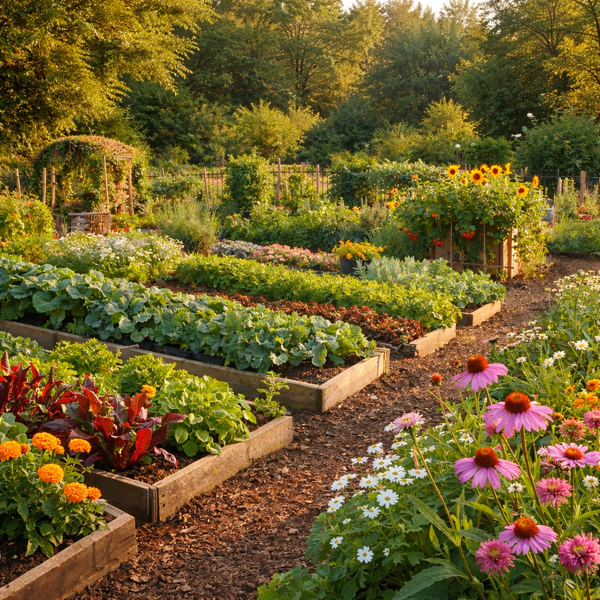
When we look at a garden, we are not just looking at plants.
We are looking at relationships.
We are looking at cycles.
We are looking at nourishment.
We are looking at intelligence that does not rush.
And spring is such a beautiful time to remember that our bodies work this way too.
You can stand in a garden and feel it right away.
The steadiness.
The interdependence.
The quiet wisdom of life unfolding in its own timing.
A leaf touches light. Roots reach down. Moisture gathers. Microbes collaborate. Nothing is separate.
And neither are we.
So often, we’ve been taught to think about healing in isolated parts. One symptom. One organ. One diagnosis. One fix.
But the body does not work in isolation.
The body is an ecosystem.
The Body Thrives Through Relationship, Not Control
What makes a garden stable is not control.
It is not force.
It is not one perfect plant doing everything on its own.
What creates resilience in a garden is diversity.
Different root depths.
Different nutrient needs.
Different growth rates.
Different relationships with water, fungi, insects, sunlight, and shade.
The healthiest garden is not a monoculture.
It is a community.
That is such an important mirror for the human body.
Our cells are in relationship.
Our nervous system is in relationship with our immune system.
Our breath is in relationship with inflammation.
Our hydration is in relationship with mineral balance.
Our tissues are in relationship with stress, rest, light, food, safety, and connection.
Just like a garden, the body becomes more stable through collaborative relationships.
Healing is rarely about forcing one part to behave.
More often, it is about improving the conditions for the whole system to work together.
The Hidden Terrain Matters More Than We Think
When we think about roots, we usually think about what is underground and hidden.
But that is where so much life happens.
Roots are not alone down there. They are communicating. They are exchanging. They are in relationship with microbes, fungi, minerals, moisture, and the architecture of the soil itself.
That hidden collaboration is part of what allows a plant to become strong, adaptable, and alive above ground.
Our bodies are like that too.
So much of what creates resilience in us is not visible.
Cellular communication.
Electrical signaling.
Fluid balance.
Mineral exchange.
The quality of the terrain inside us.
We tend to only pay attention when the leaves are drooping.
When something hurts.
When energy is low.
When inflammation rises.
When the system starts showing signs of strain.
But usually, the story began below the surface.
That is true in the garden.
And it is true in the body.
Hydration Is More Than Quantity
One of the most important reminders from both nature and physiology is this:
Water is not just about quantity.
It is also about quality.
Some researchers describe a structured phase of water, sometimes called the “fourth phase,” as a more organized state of water that may influence how water behaves near surfaces, including in living tissue.
Whether or not you use that exact language, the deeper point still matters.
Hydration in living systems is not simply about pouring more water in.
It is about structure.
It is about conductivity.
It is about the environment that allows communication to happen well.
Our cells do not just need water dumped into the system.
They need the conditions that allow water to organize, move, and support life.
And one of the things that helps create that environment is mineralization.
This matters in the body.
And it matters in the soil.
A depleted body and a depleted soil often share something in common:
They may have volume, but not enough vitality.
They may have input, but not enough usable nourishment.
Why Trace Minerals and Terrain Matter
Soil needs minerals.
It needs trace elements.
It needs replenishment from natural cycles that used to happen more regularly.
Historically, floodplains and alluvial washes would deposit minerals into the land. Rivers overflowed. Sediment spread. The land was renewed.
Many of us no longer live within those replenishing rhythms.
A lot of soil has been overworked, stripped, and disconnected from its own regenerative cycles.
And we are seeing something similar in human beings.
Many people are trying very hard to be healthy.
They are drinking water.
Eating clean.
Pushing through.
Doing all the “right” things.
And yet they still feel dry.
Exhausted.
Inflamed.
Foggy.
Wired but depleted.
Sometimes what is missing is not effort.
Sometimes what is missing is the mineral intelligence that helps the body actually use what it is receiving.
That is one reason trace minerals matter.
That is one reason quality salts can matter.
Sea salt, in appropriate amounts for the individual, can be one simple way to bring trace minerals back into the conversation.
Not as a cure-all.
Not as a trend.
But as a reminder that life requires conductivity.
Life requires mineral relationship.
Life requires terrain.
A Gentle Practice to Reconnect With Your Inner Ecosystem
You do not need to overhaul your entire life to begin listening more deeply.
Sometimes the first step is simply to pause and relate.
Try this gentle spring practice:
- Pause Outside
Step into a garden, onto your porch, or near a tree. Let yourself stop rushing for a moment. - Touch Something Living
Touch a leaf, the bark of a tree, or the soil. Notice temperature, texture, and moisture. - Ask What Is Happening Below the Surface
In nature, what you cannot see is often what makes visible life possible. Let that be true for you too. - Notice Your Terrain
Instead of asking, “What is wrong with me?” ask, “What are the conditions inside me right now?” - Listen Without Forcing
Notice whether your body needs more hydration, more minerals, more rest, more softness, or more support.
This is not about diagnosing.
It is about becoming more relational with yourself.
Rest Is Not the Opposite of Growth
Another lesson the garden teaches so beautifully is this:
Growth is not constant.
No garden is in full bloom all year.
No healthy ecosystem performs at peak output every day.
There are cycles of rest.
Cycles of dormancy.
Cycles of decomposition.
Cycles of rapid growth.
Cycles of flowering.
Cycles of pruning back.
And all of it belongs.
I think this is one of the deepest ways we have lost our way as human beings.
We have been taught to distrust rest.
To fear pauses.
To judge dormancy.
To pathologize slowness.
But in nature, rest is not failure.
Rest is preparation.
Rest is integration.
Rest is part of how life gathers itself for the next honest expression of growth.
Our bodies know this.
There are times when the body wants to mobilize.
And there are times when it wants to pull energy inward.
There are seasons for action.
And seasons for repair.
If you are in a season of less output right now, that does not necessarily mean something has gone wrong.
It may mean your system is reorganizing.
It may mean something deeper is asking for nourishment before expansion.
Spring Invites Us to Assess, Prune, and Tend
Spring is not just about blooming.
Spring is also about assessment.
In a garden, we look carefully:
- What survived the winter?
- What needs pruning?
- What needs support?
- What needs feeding?
- What needs more space?
- What needs less crowding?
- What needs to be divided?
- What needs to be left alone?
This is such a wise reflection for our inner life too.
This season invites us to ask:
- What in me is ready to grow?
- What in me needs nourishment first?
- What belief needs pruning?
- What habit has become woody or brittle?
- What relationship needs more tending?
- What pattern is taking energy but not giving life?
- What am I trying to force that actually needs time, patience, and better conditions?
That is true physically.
Emotionally.
Relationally.
Collectively.
Compost, Collapse, and Cultural Healing
We are not only living in a time of personal strain.
We are living in a time when many old structures are cracking.
You can feel it in health care.
In education.
In politics.
In community.
In family systems.
In how people relate to time, productivity, identity, and belonging.
There is strain.
There is fragmentation.
There is exhaustion.
And there is also a very real invitation.
When old systems crack, it can feel frightening.
But it can also create openings for new relationship.
New imagination.
New forms of nourishment.
New forms of cooperation.
The garden teaches us this too.
When something composts, it is not the end of usefulness.
It becomes food.
When something is pruned, it is not punishment.
It is redirection.
When soil is rebuilt, it does not happen through domination.
It happens through layering, diversity, microbial life, moisture, patience, and time.
Maybe that is where we are culturally right now.
In a profound composting.
That can feel messy.
Uncertain.
Tender.
But compost is not failure.
It is transformation in a form that does not yet look beautiful.
Deep Nourishment Changes Everything
As you move through spring, there are a few invitations we can take from the garden:
- Diversity creates resilience. Not sameness. Not rigidity. Not monoculture.
- Hidden relationships matter. What is happening below the surface matters.
- Mineralization matters. Structure matters. Terrain matters.
- Rest is part of growth. It is not separate from it.
- Pruning can be stewardship. When done with wisdom, it creates space for life.
- Nourishment is not indulgence. It is what makes sustainable healing possible.
So maybe this spring is not asking you to become a different person.
Maybe it is asking you to become a better-tended ecosystem.
Maybe it is asking:
Where am I depleted?
Where do I need more trace support?
More rest?
More relational richness?
More diversity?
More honest nourishment?
Maybe it is asking you to stop treating yourself like a machine.
And start relating to yourself more like a living garden.
Because your body is not broken.
It is responsive.
It is adaptive.
It is always trying to find stability with the resources it has.
And when we begin to nourish the terrain instead of merely managing symptoms, something deeper becomes possible.
Not instant perfection.
But real vitality.
Real resilience.
Real relationship.
Closing Reflection
That is what spring teaches.
That is what the garden teaches.
And if we let it, it can also teach us how to live through these times with more humility, more wisdom, and more care.
So as you step into this season, ask yourself:
What in me needs pruning?
What in me needs feeding?
What in me needs rest?
And what in me is quietly ready to grow?
Because deep nourishment changes everything.
See you Gaias later,
Dr. Melanie Carlone
🎥Link to full length YouTube Video here https://youtu.be/MCHtG2jf6fw
🪷Schedule your in-person or virtual wellness appointment here